



The Enduring Role of Yaskawa in Industrial Motion Control
From early electric motor manufacturing in 1915 to becoming a global leader in motion control and robotics, Yaskawa Electric has shaped modern automation. Even today, factories worldwide depend on Yaskawa servo motors, AC drives, and legacy control systems. This article explores why Yaskawa remains critical to industrial performance, why discontinued models are still in demand, and how maintaining original specifications protects production stability.
What Is Yaskawa Electric and Why Does It Remain Critical to Modern Automation?
Industrial automation is built on precision, reliability, and system continuity. Few companies have influenced this landscape as profoundly as Yaskawa Electric Corporation. For more than a century, its technologies have powered manufacturing lines, robotics systems, and motion control platforms across the world.
Even as automation evolves toward smarter and more connected systems, Yaskawa Electronics and Automation solutions remain deeply embedded in existing industrial infrastructure. Many facilities still operate machinery built around original Yaskawa servo motors, AC motor drives, and machine controllers. Understanding this legacy helps explain why the company continues to hold strategic importance in modern automation.
The Industrial Heritage of Yaskawa Electric
Founded in 1915 in Kitakyushu, Japan, Yaskawa Electric Corporation began as a manufacturer of electric motors during a period of rapid industrial expansion. Over the decades, it evolved into one of the world’s most influential suppliers of motion control systems, industrial robotics, and drive technology.
Early innovations in vector-controlled AC drives and high-response servo systems positioned the company at the forefront of factory automation. Its engineering philosophy has consistently centred on:
- Precision motion control
- Long-term durability
- Seamless system integration
These principles still underpin many modern automation architectures.
Today, Yaskawa technologies are embedded across sectors including automotive production, semiconductor fabrication, packaging automation, material handling, food processing, and advanced robotics.
Yaskawa Servo Motors – Engineering Performance That Endures
Why Are Yaskawa Servo Motors Widely Specified?
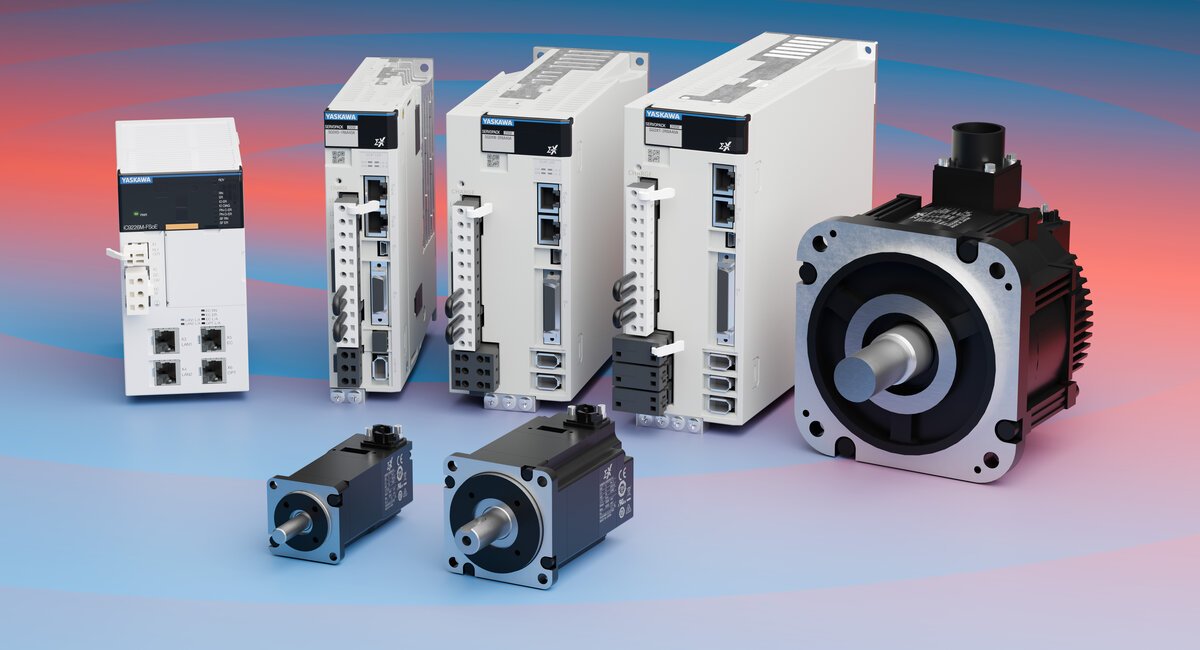
Yaskawa servo motors are recognised for high dynamic responsiveness and accurate positional control. Designed for demanding industrial environments, they offer:
- High torque density
- Low rotor inertia
- Stable low-speed operation
- Rapid acceleration and deceleration
- Excellent repeatability
- Long operational life cycles
These characteristics make them suitable for:
- CNC machining centres
- Robotic welding cells
- Pick-and-place automation
- High-speed packaging lines
- Textile and printing machinery
- Semiconductor production equipment
Many production lines were engineered specifically around these performance profiles. As a result, engineers frequently seek identical replacement units when legacy systems require maintenance.
Yaskawa AC Motor Drives – Advanced Variable Frequency Control
What Makes Yaskawa AC Drives Technically Robust?
Yaskawa AC motor drives, commonly known as VFDs, provide precise speed and torque regulation under varying load conditions. Their vector control technology ensures consistent motor performance while optimising energy consumption.
Core engineering benefits include:
- Stable torque at low speeds
- Reduced harmonic distortion
- Smooth acceleration and deceleration
- Integrated motor protection
- Improved energy efficiency
These drives are widely installed in:
- Conveyor systems
- Pump and fan applications
- HVAC installations
- Hoisting and lifting systems
- Automated production lines
When specific models are discontinued, replacing them with an exact unit often avoids complex recalibration and system redesign.
Machine Controllers and Integrated Motion Platforms
Why Are Yaskawa Controllers Challenging to Replace?
Yaskawa machine controllers are rarely standalone components. They are typically integrated into synchronised automation environments, communicating with:
- Servo amplifiers
- Encoders
- PLCs
- HMIs
Replacing a legacy controller with a newer platform can require:
- PLC reprogramming
- Firmware migration
- Communication protocol conversion
- Mechanical redesign
- Extended commissioning periods
For facilities aiming to preserve validated process stability, sourcing the original controller is often the most efficient and lowest-risk option.
Why Are Certain Yaskawa Parts No Longer Available?
As product lifecycles evolve, many earlier-generation servo motors, AC drives, and controllers have been phased out. Although newer digital platforms exist, they are not always directly compatible with legacy systems.
Thousands of operational facilities continue to depend on these discontinued models. However, many parts are no longer available directly from the manufacturer.
K2 Automation serves as a dedicated source for legacy Yaskawa components, supporting facilities that require like-for-like replacements to maintain operational continuity.
Engineering Risks of Substituting Alternative Brands
When original models cannot be sourced, substituting alternative brands may introduce technical challenges, including:
- Servo tuning instability
- Torque mismatches
- Encoder compatibility issues
- Communication conflicts
- Increased vibration
- Prolonged commissioning times
Maintaining original specifications reduces engineering risk and protects validated production processes. In high-output facilities, even minor compatibility issues can translate into measurable downtime costs.
Industries Dependent on Legacy Yaskawa Systems
Discontinued Yaskawa components remain embedded across numerous industrial sectors, including:
- Automotive manufacturing
- Aerospace engineering
- Food and beverage processing
- Pharmaceutical production
- Electronics assembly
- Heavy industrial machining
In these environments, downtime carries significant financial and operational consequences. Rapid access to original components is therefore not simply convenient; it is strategically essential.
Looking for Discontinued Yaskawa Servo Motors or Drives?
For engineers and maintenance teams seeking discontinued Yaskawa servo motors, AC motor drives, or machine controllers that are no longer available from the manufacturer, specialist sourcing is often the most practical solution.
K2 Automation provides access to legacy Yaskawa electronics and automation components, helping facilities maintain system integrity without introducing redesign risk.
Conclusion
For more than a century, Yaskawa Electric Corporation has shaped industrial motion control and automation architecture. Its servo motors, AC drives, and controllers remain embedded in factories worldwide.
While newer technologies continue to emerge, many production environments still rely on legacy Yaskawa systems engineered for precision and durability. Preserving these systems through like-for-like replacement often protects stability, reduces risk, and minimises downtime.
In modern automation, continuity can be just as critical as innovation.
Frequently Asked Questions (FAQs) about Yaskawa Electric
Why are discontinued Yaskawa servo motors still in demand?
Many production systems were engineered around specific torque curves, encoder resolutions, and tuning parameters. Replacing them with newer models often requires recalibration and redesign. Engineers therefore seek identical discontinued units to maintain system stability and minimise downtime.
Can obsolete Yaskawa AC drives be repaired instead of replaced?
Repair may be possible, but when internal components are no longer manufactured, sourcing an identical discontinued drive ensures compatibility. This approach avoids reprogramming motors or reconfiguring associated control systems.
Why not upgrade to newer Yaskawa models?
Upgrading can involve firmware changes, PLC adjustments, and mechanical modifications. For operational facilities, like-for-like replacement is often more cost-effective and less disruptive than system-wide upgrades.
How does sourcing original components protect system performance?
Using identical replacement parts preserves mechanical alignment, servo tuning parameters, and communication protocols. This reduces commissioning time and ensures predictable performance within established automation architectures.
 Anderson Wilson